
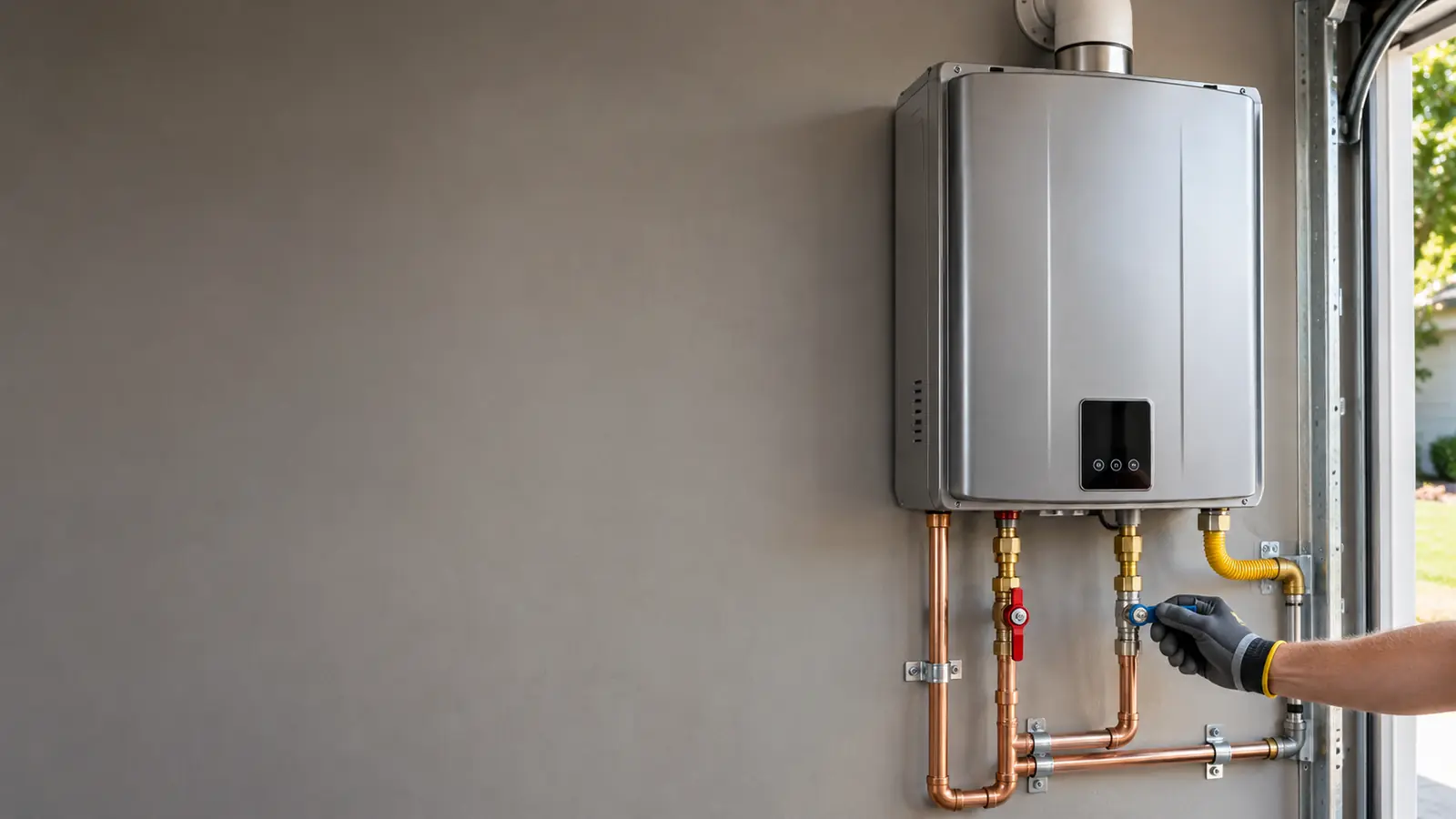
What Is Included in a Tankless Installation?
A tankless conversion is more than swapping one box for another. Our installation includes:
- Sizing by flow rate (gallons per minute) and the number of bathrooms
- Gas line upgrade when the existing line is too small for the burner
- New venting through the wall or roof to the manufacturer's specification
- Isolation valves for easy descaling service
- Permit and inspection with LADBS
- Removal of the old tank
Is a Tankless Water Heater Right for Your Home?
Tankless is usually a good fit when:
- Your family runs out of hot water during showers
- Your current tank is near the end of its life
- You want to free up garage or closet space
- You plan to stay in the home long enough to recover the higher install cost
Tank vs Tankless: Key Differences
| Factor | Tank | Tankless |
|---|---|---|
| Hot water supply | Limited to tank size | Continuous |
| Typical lifespan | 8–12 years | 15–20 years |
| Install cost | Lower | Higher (gas and vent work) |
| Standby energy loss | Yes | None |
| Maintenance | Annual flush | Annual descaling |
Why Tankless Units Need Descaling Here
Hard water leaves scale inside the heat exchanger of a tankless unit. Scale reduces flow and triggers error codes. We recommend descaling once a year in Granada Hills, or adding a water softener or scale filter to protect the warranty.
How Does a Tankless Water Heater Work?
A tankless water heater heats water as it flows through the unit. Opening a hot water tap starts water moving, a flow sensor detects it, and a gas burner or electric elements fire. The water passes through a heat exchanger and leaves at the set temperature. When the tap closes, the heater shuts off, so no energy is spent keeping stored water hot.
How to Size a Tankless Water Heater
A tankless unit is sized by flow rate, measured in gallons per minute (gpm), at the temperature rise your home needs. Add up the fixtures that run at the same time during your busiest hour. California sets maximum flow rates for new fixtures, which keeps the numbers predictable:
| Fixture | California maximum flow |
|---|---|
| Showerhead | 1.8 gpm |
| Kitchen faucet | 1.8 gpm |
| Bathroom faucet | 1.2 gpm |
Two showers and a kitchen faucet running together draw up to about 5.4 gpm, most of it hot water. Older fixtures use more, so we measure your actual flow before choosing a unit.
Gas vs Electric Tankless Water Heaters
| Factor | Gas tankless | Electric tankless |
|---|---|---|
| Flow capacity | High, suits whole homes | Lower, suits small homes or single points of use |
| Installation needs | Gas line sizing and venting | Large electrical service and dedicated circuits |
| Works in a power outage | No, controls need electricity | No |
| Best fit | Most Granada Hills single-family homes | ADUs, all-electric homes, remote bathrooms |
Tankless Water Heater Maintenance
Annual descaling keeps a tankless unit efficient in hard water. The service follows these steps:
- Turn off the power and gas to the unit.
- Close the isolation valves on the hot and cold lines.
- Connect a small pump and hoses to the service ports.
- Circulate a descaling solution through the heat exchanger for the time the manufacturer specifies.
- Flush with clean water and clean the inlet water filter.
- Reopen the valves, restore power and gas, and check for error codes.
Common Tankless Water Heater Problems
- Error codes for scale or overheating: the heat exchanger needs descaling.
- Ignition failure: the gas supply is too small, the igniter is worn, or the vent is blocked.
- Brief cold water between uses: water left in the pipes cools before the heater restarts. A recirculation system shortens the wait.
- Heater shuts off at low flow: the faucet flow is below the unit's minimum activation rate.
Hot Water Recirculation with Tankless Heaters
A recirculation system shortens the wait for hot water at faucets far from the heater. Many tankless units have a built-in pump or accept an add-on kit, and a timer or motion sensor runs it only when hot water is likely to be needed. Recirculation is useful in larger Granada Hills and Porter Ranch homes where the water heater sits in the garage at one end of the house.
What Affects Tankless Installation Cost?
- Gas line work: whether the line from the meter needs upsizing
- Venting: new vent runs through a wall or roof
- Location: the same spot as the old tank, or a new wall
- Unit size and features such as built-in recirculation
- Condensate drain for high-efficiency condensing models
- Permit and inspection
Tankless Water Heater Warranty Tips
Most tankless warranties require installation by a licensed professional and regular maintenance. Keep your installation invoice and descaling records, and register the unit with the manufacturer after installation.
Our Tankless Water Heaters Process
- Measure hot water demand
- Check gas meter and line size
- Recommend a unit and quote
- Install, vent and pull permit
- Test flow and teach you the controls
Related Plumbing Services
- Water Heater Repair & ReplacementTank water heaters repaired, replaced, strapped and permitted to California code.
- Gas Line Repair & InstallationGas leak repair, new appliance lines and seismic gas shut-off valves.
- Water Softeners & FiltrationSofteners, scale filters and drinking-water systems for hard Valley water.
Helpful Guides
- Water Heater Repair or Replace? 6 Ways to Decide
- Hard Water in the San Fernando Valley: Effects on Plumbing
- Tank vs Tankless Water Heaters for San Fernando Valley Homes
Tankless Water Heaters FAQs
Does a tankless water heater need a bigger gas line?
Often, yes. A gas tankless unit can use several times more gas per hour than a tank. Many Granada Hills homes need a larger line from the meter.
Can a tankless heater run several showers at once?
Yes, when it is sized correctly. We size by the peak flow your household uses, such as two showers and a dishwasher at the same time.
Do tankless water heaters need seismic strapping?
No. Wall-mounted tankless units are bolted to the structure instead, but their gas and water connections still must meet code.
Does a tankless water heater work during a power outage?
No. Gas tankless units need electricity for their controls, igniter and fan, so they stop during a power outage.
How long does a tankless installation take?
A replacement in the same location usually takes one day. A conversion that needs a new gas line and venting can take one to two days.
Can a tankless unit go in the same spot as my old tank?
Often, yes, if venting and gas supply can reach it. Many installs mount the unit on the wall where the tank stood.
Do tankless water heaters need a special vent?
Yes. Gas tankless units need venting rated for their exhaust, often stainless steel or, for condensing models, approved plastic pipe.