
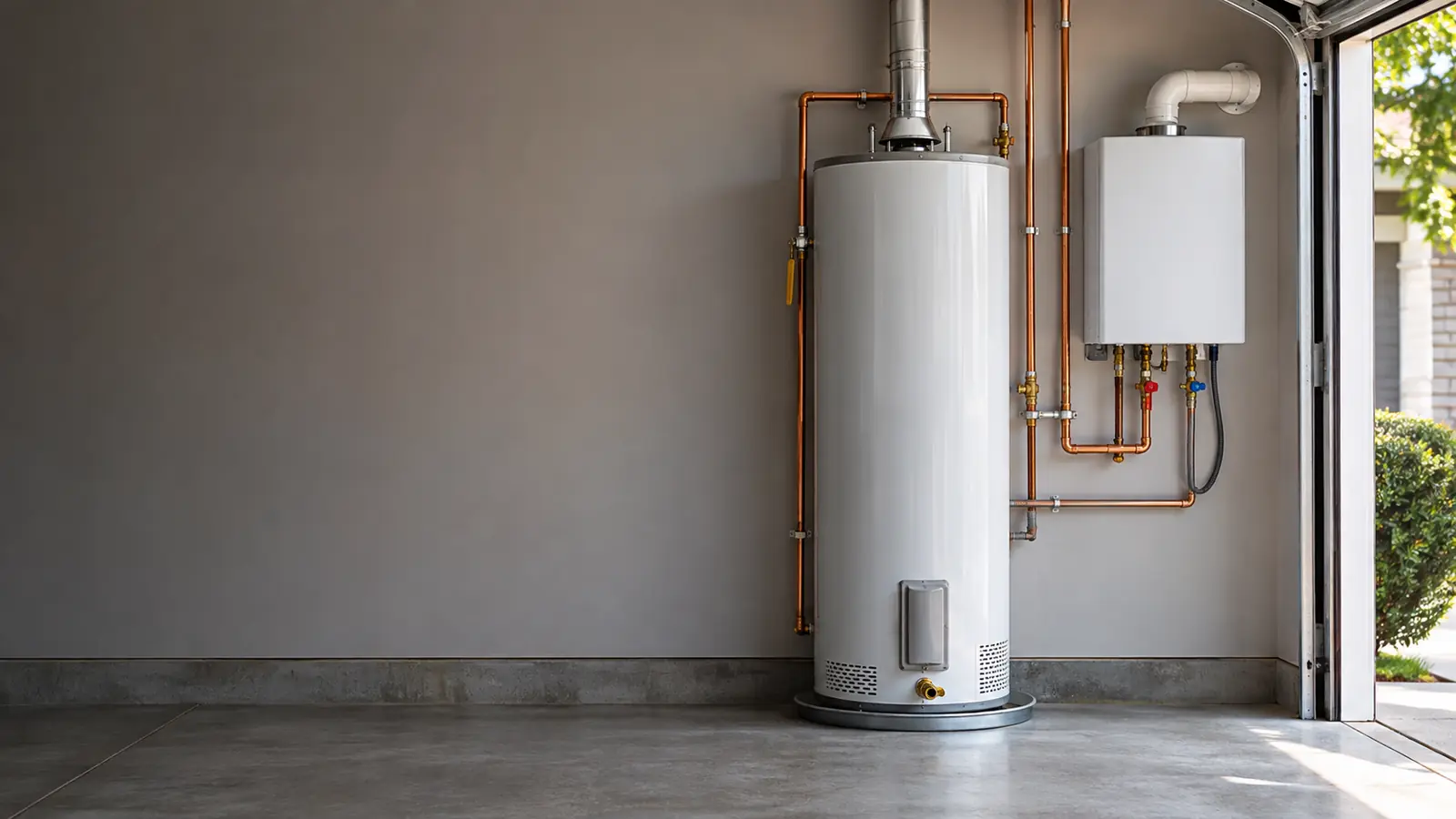
A tankless water heater suits homes that run out of hot water and plan to stay long term. A tank heater suits budgets that favor lower upfront cost. Tankless saves more energy in homes using less hot water.
How Tank and Tankless Water Heaters Differ
A tank water heater keeps 40 to 75 gallons of water hot at all times and refills as you use it. A tankless water heater heats water only when a tap opens, so it never runs out but has a limit on how much hot water it can deliver at once. That one difference shapes cost, energy use and fit.
| Factor | Tank | Tankless |
|---|---|---|
| Hot water supply | Limited by tank size | Continuous, limited by flow rate |
| Upfront cost | Lower | Higher, often with gas and vent work |
| Typical lifespan | 8–12 years (gas) | 15–20 years |
| Standby heat loss | Yes | None |
| Space | Floor space in garage or closet | Wall-mounted |
| Hard water upkeep | Annual flush | Annual descaling |
How Much Energy Does Tankless Save?
Savings depend on how much hot water your household uses. According to the U.S. Department of Energy, demand (tankless) water heaters can be 24% to 34% more energy efficient than storage tanks in homes that use 41 gallons or less of hot water a day, and 8% to 14% more efficient in homes that use around 86 gallons a day.
Smaller households see the largest percentage savings, because a tank wastes more energy keeping water hot that nobody uses. Larger households still save, but the higher installation cost takes longer to recover.
When a Tank Water Heater Is the Better Choice
- The current tank met your needs and you want the lowest replacement cost
- You plan to sell the home within a few years
- The gas line or venting would need costly changes for tankless
- You want hot water during a power outage from a standing-pilot gas tank
When Tankless Is the Better Choice
- Your family runs out of hot water during back-to-back showers
- You want to free garage or closet space
- You plan to stay in the home long enough to benefit from the longer lifespan
- You are remodeling and can plan gas line and vent routing at the same time
Hard Water and Tankless Heaters in the Valley
San Fernando Valley water is moderately hard to hard. Scale builds up inside a tankless heat exchanger faster than in a tank, so tankless units here need descaling about once a year, and many owners add a softener or scale filter. Factor that maintenance into the decision. See our guide to hard water in the San Fernando Valley.
Installation Differences That Affect Cost
Replacing a tank with a tank usually reuses the same gas line, vent and location. Switching to tankless often needs a larger gas line from the meter, a new vent through the wall or roof, a condensate drain for condensing models and an electrical outlet. Those changes, not the unit price alone, explain most of the difference between quotes.
Heat Pump Water Heaters: A Third Option
A heat pump water heater is a tank heater that moves heat from the surrounding air into the water instead of burning gas or heating an element directly. It suits homes moving toward all-electric appliances and garages with enough space and airflow. Like any tank, it needs seismic strapping.
Space and Placement in Valley Homes
Most Granada Hills water heaters sit in the garage or an exterior closet. A tank needs floor space, seismic straps and, in many garages, a raised stand. A tankless unit mounts on a wall, often in the same spot, and frees the floor for storage. Tankless units need clearance for venting and service, and exterior models must be rated for outdoor installation.
Five Questions to Help You Decide
- Do you run out of hot water now?
- How long do you plan to stay in the home?
- Can your gas line and meter supply a tankless unit without upgrades?
- Are you willing to descale the unit every year?
- Is your budget focused on upfront cost or long-term cost?
If you answered yes to the first and long-term to the last, tankless is usually the better fit.
What Changes When You Switch to Tankless
Switching from a tank to tankless changes more than the appliance. The gas line often needs to be larger, because a tankless burner draws far more gas while it runs than a tank's burner does. The old vent usually cannot be reused; tankless units need their own vent rated for their exhaust, and condensing models add a small drain for acidic condensate. The unit needs an electrical outlet for its controls and fan. Plumbing changes are usually simple, but the plumber may add isolation valves so the unit can be descaled. All of this is normal, and it is why tankless quotes vary so much from house to house. Ask each plumber to list the gas, vent and electrical work in the quote.
Comfort Differences You Will Notice
With tankless, long showers no longer run cold and back-to-back showers stay hot. The wait for hot water at a distant faucet is about the same, since water still travels through the pipes. Some owners notice a short burst of cooler water between uses, which a recirculation feature reduces.
When to Call a Plumber
If this guide matches what you see at home, our licensed plumbers can inspect it and give you a written price. Call (747) 285-3582 to book a plumbing inspection.
Related Questions
Does a tankless water heater save money in Granada Hills?
It can, through lower energy use and a longer lifespan. Savings depend on household hot water use, gas rates and installation cost.
Can a tankless heater supply a large family?
Yes, when it is sized for peak flow. Some large homes use two units in series or a model with built-in recirculation.
Do tankless heaters take longer to deliver hot water?
They take about the same time, since hot water still travels through the pipes. A recirculation system shortens the wait.
Do tankless water heaters need maintenance?
Yes. In hard water areas, plan on descaling once a year and cleaning the inlet filter.