
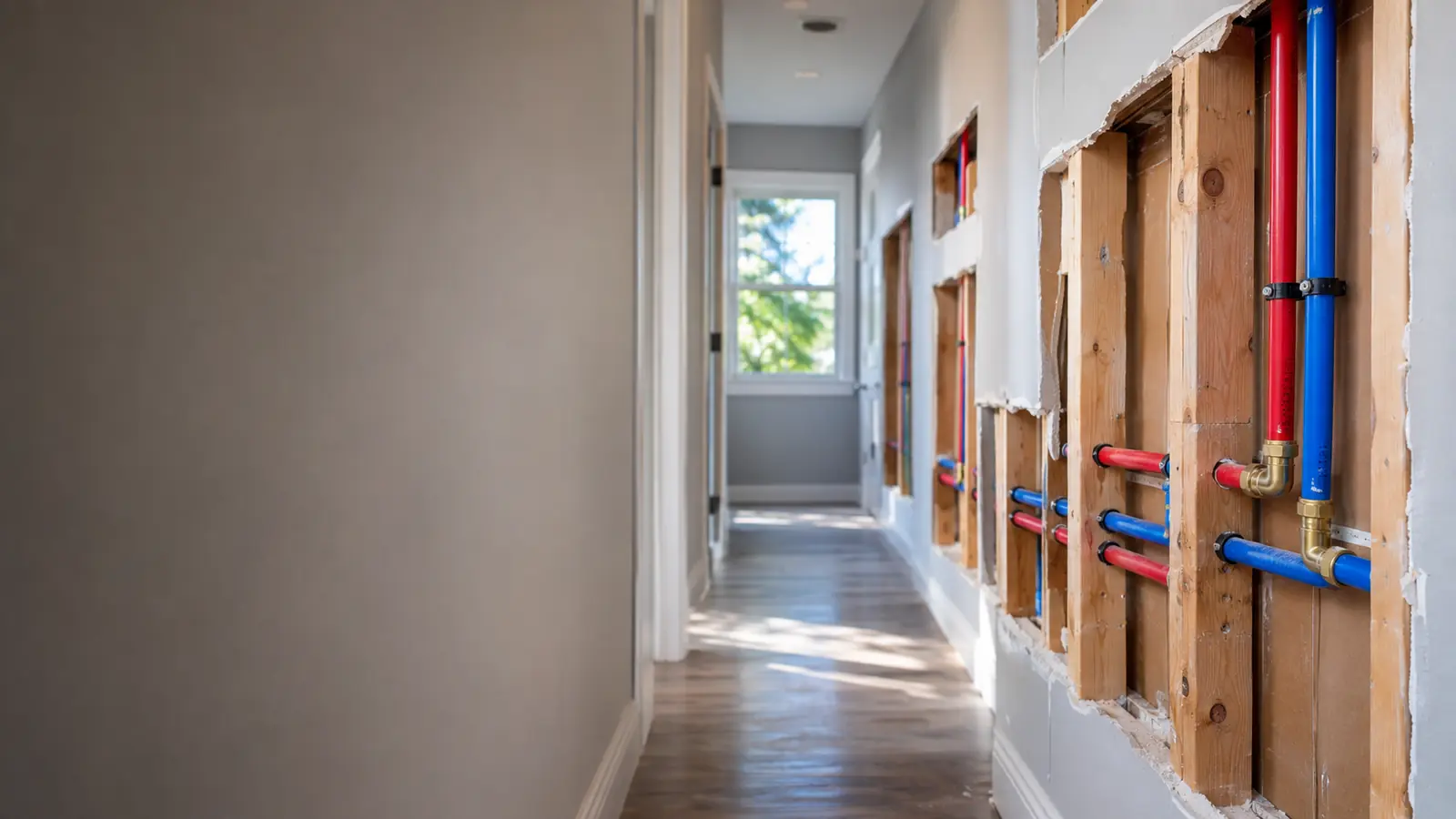
A whole-house repipe averages about $7,500 nationally, with most homeowners spending $1,500 to $15,000, according to Angi. Home size, pipe material and access drive the final price.
National Repiping Costs
According to Angi, the national average cost to repipe a house is $7,500, and most homeowners spend between $1,500 and $15,000 depending on home size, pipe material and how much of the system is replaced. Angi lists pipe material prices of about $0.40 to $2 per linear foot for PEX and $2 to $8 per linear foot for copper.
Material is a small share of the total. Labor to open walls, route pipe, connect fixtures and patch drywall makes up most of a repipe bill.
National averages are a starting point. Los Angeles projects often cost more than the national figures because of higher labor rates, city permit fees and the age of local homes. A written quote after an inspection is the only reliable number for your home.
What Drives the Cost of a Repipe
| Factor | Effect on price |
|---|---|
| Number of bathrooms and fixtures | More connections and more pipe |
| Pipe material | Copper costs more to buy and install than PEX |
| Single-story vs two-story | Two-story homes need vertical runs through walls |
| Attic access | Good attic access shortens routing |
| Wall finishes | Tile and plaster take longer to open and patch |
| Main water line | Replacing the line from the meter adds cost |
| Permit and patching | Usually included in a complete quote |
Typical Granada Hills Repipe Projects
Most Granada Hills repipes are single-story slab homes from the 1950s and 1960s with original galvanized supply pipe or copper that has started to leak under the slab. In these homes, new lines usually run through the attic and drop down inside walls to each fixture, which avoids the slab entirely. Read about galvanized pipes in older homes to see whether your home fits this pattern.
Whole-House vs Partial Repipe
A partial repipe replaces only the worst section, such as one bathroom or a leaking slab line. It costs less now but leaves old pipe in place. A whole-house repipe costs more but ends rusty water, low pressure and repeat leaks at once. For homes with galvanized pipe throughout, a whole-house repipe is usually the better value.
Ways to Keep Repipe Costs Down
- Choose PEX unless you have a specific reason for copper
- Repipe before a remodel while walls are open
- Repipe after a second leak instead of paying for several spot repairs
- Ask what patching includes so you can plan painting separately
Comparing Repipe Quotes
- Confirm every fixture and hose bib is included.
- Check whether the main line from the meter is included.
- Confirm the pipe type: PEX-A, PEX-B or Type L copper.
- Ask whether drywall patching and the permit are included.
- Ask for the warranty on labor and materials in writing.
Our guide to PEX vs copper repiping compares the materials in detail.
What Living Through a Repipe Is Like
Most families stay home during a repipe. Crews arrive in the morning, shut off water during work hours and restore it each evening on most jobs. Expect noise, small wall openings and some dust in work areas. Plan to clear access to bathrooms, the kitchen, the laundry and the water heater, and to keep pets away from the work.
Signs It Is Time to Budget for a Repipe
- Two or more slab or wall leaks within a few years
- Rusty or discolored water from the cold tap
- Low pressure at several fixtures
- Galvanized steel pipe visible at the water heater or hose bibs
- Green corrosion or pinholes on copper
Repiping Before You Sell
Home inspectors flag galvanized supply pipe and evidence of past leaks, and buyers often ask for credits. Repiping before listing, with the permit record and warranty in hand, removes a common negotiation point.
How Repiping Prices Are Calculated
Most plumbers price a repipe by the number of fixtures and the layout of the home rather than by the foot of pipe. Each toilet, sink, tub, shower, hose bib, washer box and the water heater counts as a connection, and each needs a run from the main line. A single-story home with good attic access is the simplest case, because lines run across the attic and drop straight into walls. Two-story homes, homes without attic space and homes with plaster or tile walls take more time and patching. Quotes should state whether the main line from the meter to the house is included, since it is a separate pipe that often needs replacing in homes with galvanized plumbing.
Is a Repipe Worth It?
For a home with original galvanized pipe or repeated slab leaks, a repipe usually costs less over the next decade than continued spot repairs, water damage and low pressure. A repipe removes a common inspection issue when you sell. For a newer home with one leak, a targeted repair is often enough.
Repipe Financing and Timing
Many homeowners plan a repipe around a remodel, a home sale or the end of a water heater's life, since walls and fixtures may already be open. Ask your plumber whether they offer financing, and schedule the work before leaks force an emergency repair.
When to Call a Plumber
If this guide matches what you see at home, our licensed plumbers can inspect it and give you a written price. Call (747) 285-3582 to book a plumbing inspection.
Related Questions
How long does a whole-house repipe take?
Most single-family homes take 2 to 5 days, with water restored at the end of most days.
Is copper worth the extra cost?
It depends on your priorities. Copper is proven and rigid; PEX costs less, installs faster and resists hard water scale.
Does repiping require a permit?
Yes. A repipe requires a plumbing permit and inspection before walls are closed.
Will my walls be damaged?
Small access openings are made and patched. Painting is often a separate step.