
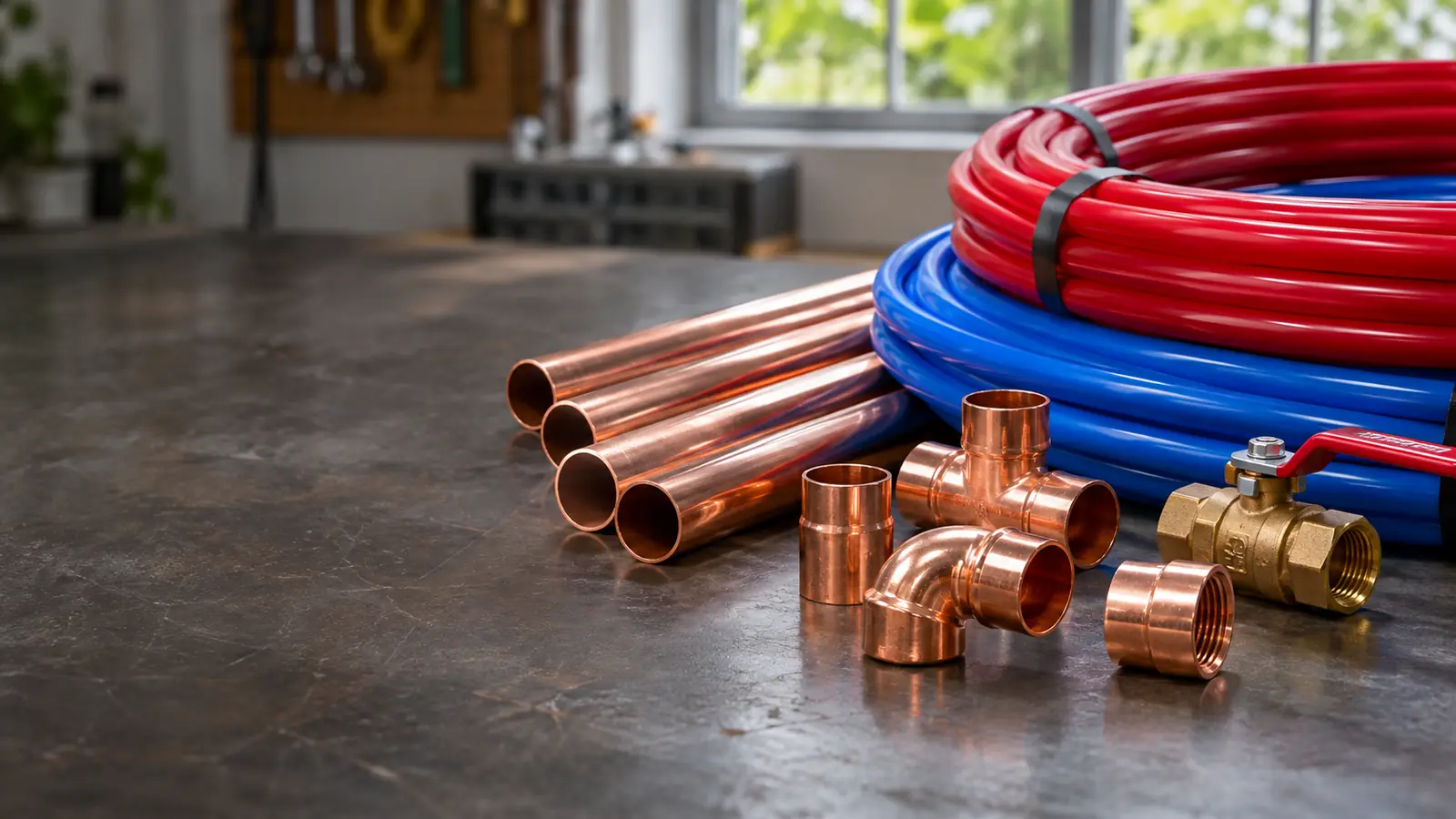
PEX costs less, installs faster, flexes in earthquakes and resists hard water scale. Copper is rigid, heat tolerant and long proven. Most Granada Hills repipes use PEX unless the owner prefers copper.
PEX and Copper at a Glance
| Factor | PEX | Copper (Type L) |
|---|---|---|
| Material cost | Lower | Higher |
| Installation speed | Faster; long flexible runs, fewer fittings | Slower; joints are soldered |
| Wall openings | Fewer | More |
| Hard water | Resists scale and pinholes | Can pinhole over time |
| Earthquake movement | Flexible | Rigid |
| Sunlight exposure | Must be protected from UV | Not affected |
| Noise | Quieter water flow | Can transmit water hammer noise |
What Is PEX?
PEX is cross-linked polyethylene, a flexible plastic pipe approved by the California Plumbing Code for home water supply. It comes in coils, so long runs need few fittings. PEX-A uses expansion fittings and is the most flexible type; PEX-B uses crimp or clamp fittings and is stiffer. Both types are color-coded red and blue for hot and cold lines.
What Is Copper Pipe?
Copper has been the standard for home water supply for decades. It comes in rigid lengths joined with soldered fittings. Wall thickness is graded Type K, L and M; Type L has a thicker wall than Type M and is the usual choice for repipes. Copper tolerates heat and sunlight and has a long track record.
Cost Difference
Material prices show the gap. Angi lists PEX at about $0.40 to $2 per linear foot and copper at $2 to $8 per linear foot. Labor widens the difference, because PEX runs through walls and attics in long continuous lengths while copper needs a soldered joint at every turn. See our repiping cost guide for whole-house figures.
Which Pipe Handles Hard Water Better?
PEX resists the scale and pinhole corrosion that hard water and high water pressure can cause in copper over many years. In the San Fernando Valley, where LADWP water is moderately hard to hard, that is a practical advantage. Copper still performs well, especially with a pressure regulator kept at or below 80 psi.
Which Pipe Handles Earthquakes Better?
PEX bends with movement, while rigid copper joints can crack when framing shifts. In earthquake country, PEX's flexibility is a real benefit. Proper strapping and flexible connections at appliances matter for both materials.
When Copper Makes Sense
- Exposed pipe runs where sunlight could reach PEX
- Homeowners who prefer a metal system for resale reasons
- Short repairs that connect to existing copper
- Areas near high-heat equipment
Lifespan and Warranties
Both materials are expected to last for decades when installed correctly. Copper has the longer history in homes. PEX manufacturers commonly offer long system warranties when their pipe and fittings are installed together by a licensed plumber. Ask for the manufacturer's warranty in writing, along with your plumber's labor warranty.
PEX Fitting Types
| Fitting | Used with | How it works |
|---|---|---|
| Expansion | PEX-A | Pipe is expanded, slid over the fitting and shrinks back to seal |
| Crimp or clamp | PEX-A or PEX-B | A metal ring is compressed around the pipe and fitting |
| Press | PEX and copper | A sleeve is pressed with a powered tool |
How Each Material Installs in a Slab Home
Most Granada Hills homes sit on concrete slabs, so a repipe runs new lines through the attic and down inside walls rather than under the floor. PEX suits that route well because one continuous length can travel from the attic manifold to a fixture without joints inside the wall. Copper follows the same route with fittings at each turn.
Manifold vs Branch Layouts
A PEX repipe can use a manifold, a central block with a separate line and valve for each fixture, or a branch layout with trunk lines and tees. A manifold lets you shut off one fixture at a central point and gives steadier pressure when several fixtures run. Branch layouts use less pipe.
Common Myths About PEX and Copper
- "PEX is new and untested." PEX has been used for home water supply for decades and is approved by the California Plumbing Code.
- "Copper never leaks." Copper can develop pinhole leaks over many years, especially with high pressure or aggressive water.
- "PEX lowers home value." Buyers and inspectors look for a permitted, professionally installed system; material matters less than condition.
- "Copper is always better for hard water." PEX resists scale buildup, while copper can scale and pit over time.
Our Recommendation for Most Granada Hills Homes
For most single-story slab homes in Granada Hills, PEX is the practical choice for a whole-house repipe. It costs less, installs faster with fewer wall openings, flexes with ground movement and resists hard water scale. Copper remains a good option for owners who prefer a metal system, for exposed runs and for repairs that join existing copper. Whichever you choose, the quality of the installation, the permit and the inspection matter more than the material.
Questions to Ask Your Plumber
- Which type of PEX or copper do you install, and why?
- Will you use a manifold or branch layout?
- How will pipe be protected in the attic and through framing?
- What warranty covers materials and labor?
When to Call a Plumber
If this guide matches what you see at home, our licensed plumbers can inspect it and give you a written price. Call (747) 285-3582 to book a plumbing inspection.
Related Questions
Does PEX affect water taste?
PEX certified for drinking water meets health standards. Some people notice a slight taste in new pipe that fades as water runs through it.
Can rodents damage PEX?
Rodents can chew plastic pipe in attics and crawl spaces. Sealing entry points and protecting exposed runs reduces the risk.
Can PEX and copper be mixed?
Yes. Approved transition fittings connect PEX to existing copper, which is common in partial repipes.
Is PEX allowed in Los Angeles?
Yes. PEX is approved by the California Plumbing Code for home water supply.