
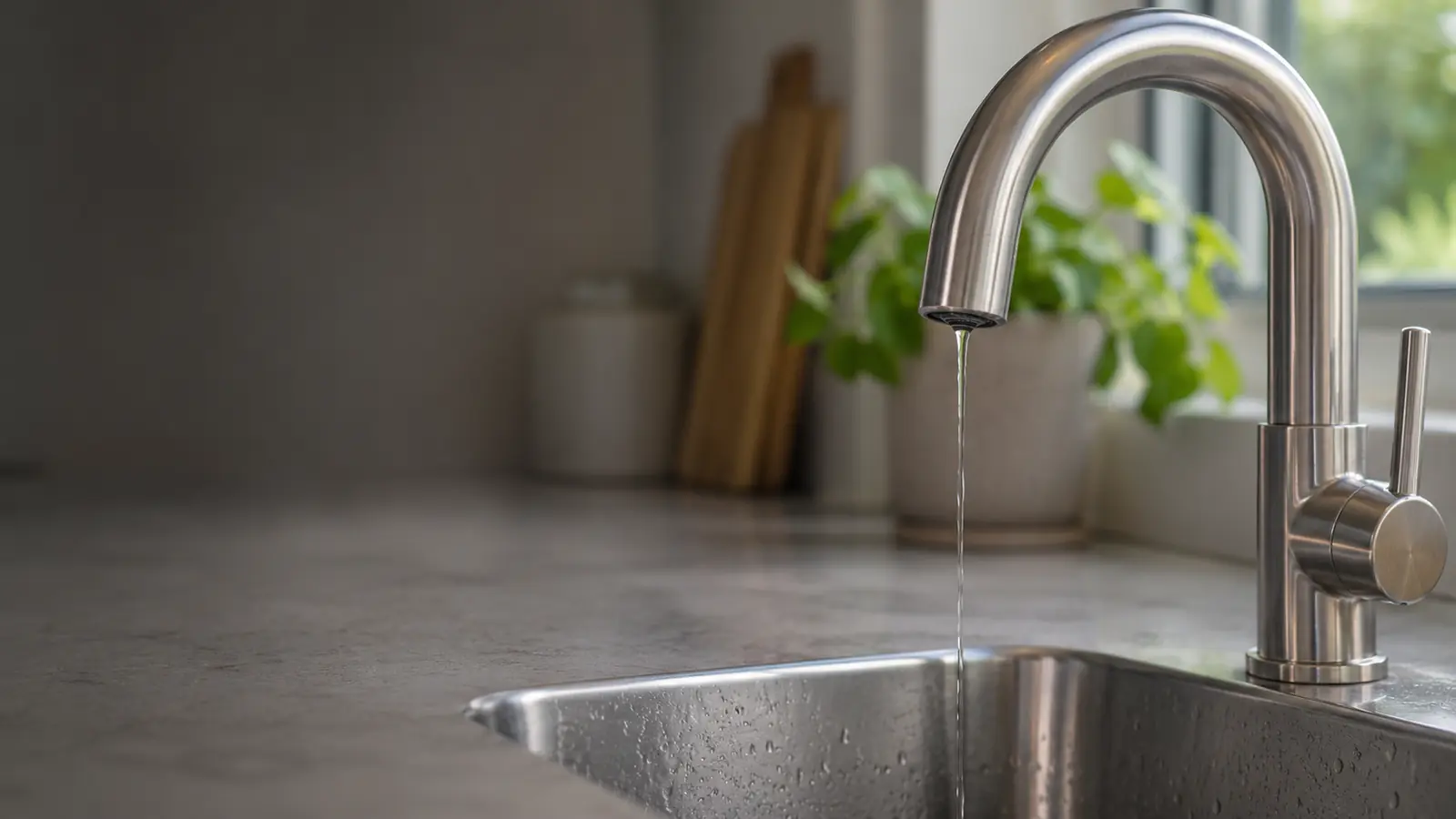
Low water pressure usually comes from clogged aerators, a failing pressure regulator, a partly closed valve, corroded galvanized pipe, a hidden leak or a utility supply problem. Check whether one fixture or the whole house is affected.
Start Here: One Fixture or the Whole House?
Where the low pressure appears points to the cause. Low pressure at a single faucet or shower is usually a problem in that fixture. Low pressure everywhere points to the main line, the pressure regulator, the pipes or the water supply.
8 Causes of Low Water Pressure
- Clogged aerators and shower heads. Hard water scale blocks the small screens and nozzles.
- Worn faucet cartridges. Scale and wear restrict flow inside the valve.
- A partly closed valve. The main shut-off or a fixture stop was not fully reopened after work.
- Failing pressure regulator. The bell-shaped valve near the main line can fail low as it ages.
- Corroded galvanized pipe. Rust narrows the inside of old steel pipe.
- A hidden leak. Water escaping from a slab or yard line leaves less for fixtures.
- Water heater problems. Sediment or a partly closed valve lowers hot water pressure only.
- Utility supply issues. Main work or high demand can lower street pressure temporarily.
How to Diagnose Low Pressure Yourself
- Check whether the problem is hot, cold or both.
- Unscrew and clean the aerator on the affected faucet.
- Confirm the main shut-off and fixture stops are fully open.
- Ask neighbors whether they have low pressure too.
- Check the water meter's leak indicator with every fixture off.
- Attach a pressure gauge to a hose bib; normal home pressure is often between 40 and 80 psi.
Low Pressure in Older Granada Hills Homes
Original galvanized supply pipe is the most common cause of whole-house low pressure in homes built in the 1950s and 1960s. Rust narrows the pipe from the inside, flow drops at every fixture, and rust flakes clog aerators. Cleaning cannot restore the pipe. A whole-house repipe brings back full pressure. Our guide to galvanized pipes explains how to identify them.
High Pressure Is a Problem Too
The California Plumbing Code requires a pressure regulator where static water pressure exceeds 80 psi, because high pressure strains pipes, fixtures and water heaters. A regulator that fails can let pressure climb too high as well as drop too low, so test pressure whenever a regulator is suspected.
Fixes and Who Should Do Them
| Cause | Fix | DIY or plumber |
|---|---|---|
| Clogged aerator | Clean or replace | DIY |
| Partly closed valve | Open fully | DIY |
| Worn cartridge | Replace | DIY or plumber |
| Failed regulator | Replace and test | Plumber |
| Galvanized pipe | Repipe | Plumber |
| Hidden leak | Leak detection and repair | Plumber |
How a Pressure Regulator Works
A pressure regulator, or pressure-reducing valve, sits on the main line where water enters the house. A spring and diaphragm reduce high street pressure to a set level for the home. Over time, scale and wear can make the regulator stick, so pressure drops too low or climbs too high. Many regulators have an adjustment screw, but a worn one usually needs replacing.
Low Pressure After Plumbing Work
Pressure that drops right after plumbing or utility work usually has a simple cause. A shut-off valve may not be fully open, or loosened debris may have clogged aerators and fixture screens. Open every valve fully and clean the aerators. If pressure stays low, call a plumber to check the regulator and lines.
Pressure Checklist for Homeowners
- Clean aerators and shower heads every few months
- Test home pressure with a hose bib gauge once a year
- Watch for rusty water or pressure loss over time
- Check the water meter for hidden leaks
Low Pressure in Granada Hills Homes
Granada Hills homes range from the flat streets near Chatsworth Street to hillside lots north of the 118, and water pressure varies with elevation and distance from supply lines. Low-lying homes may receive high street pressure that a regulator must reduce, while some hillside homes see lower pressure. Add the area's many original galvanized supply lines, and pressure complaints have several possible sources. Testing the pressure at a hose bib with a gauge is the fastest way to tell whether the problem starts at the street, the regulator or inside the home.
When Low Pressure Means a Leak
A sudden drop in pressure at every fixture, along with a higher water bill or the sound of running water, can mean a leak in the main line or under the slab. Close every fixture and watch the water meter's leak indicator. If it moves, schedule leak detection before the leak causes damage. See our guide to slab leak signs.
Signs Your Pressure Is Too High
Banging pipes, dripping faucets, running toilets and relief valves that discharge at the water heater can point to pressure that is too high, not too low. Test with a gauge and have the regulator checked if readings exceed 80 psi.
When to Call a Plumber
If this guide matches what you see at home, our licensed plumbers can inspect it and give you a written price. Call (747) 285-3582 to book a plumbing inspection.
Related Questions
Why is only my hot water pressure low?
The cause is usually at the water heater: sediment in the tank, a partly closed valve or a failing dip tube or fitting.
Does LADWP fix low water pressure?
LADWP handles the supply up to the meter. Pressure problems on your side of the meter, such as pipes or the regulator, are the owner's responsibility.
Can a water softener lower pressure?
A correctly sized softener has little effect. An undersized unit or clogged filter can reduce flow.
How do I know if my pressure regulator is failing?
Pressure that drops, spikes or changes from day to day, or banging pipes, can point to a failing regulator.