
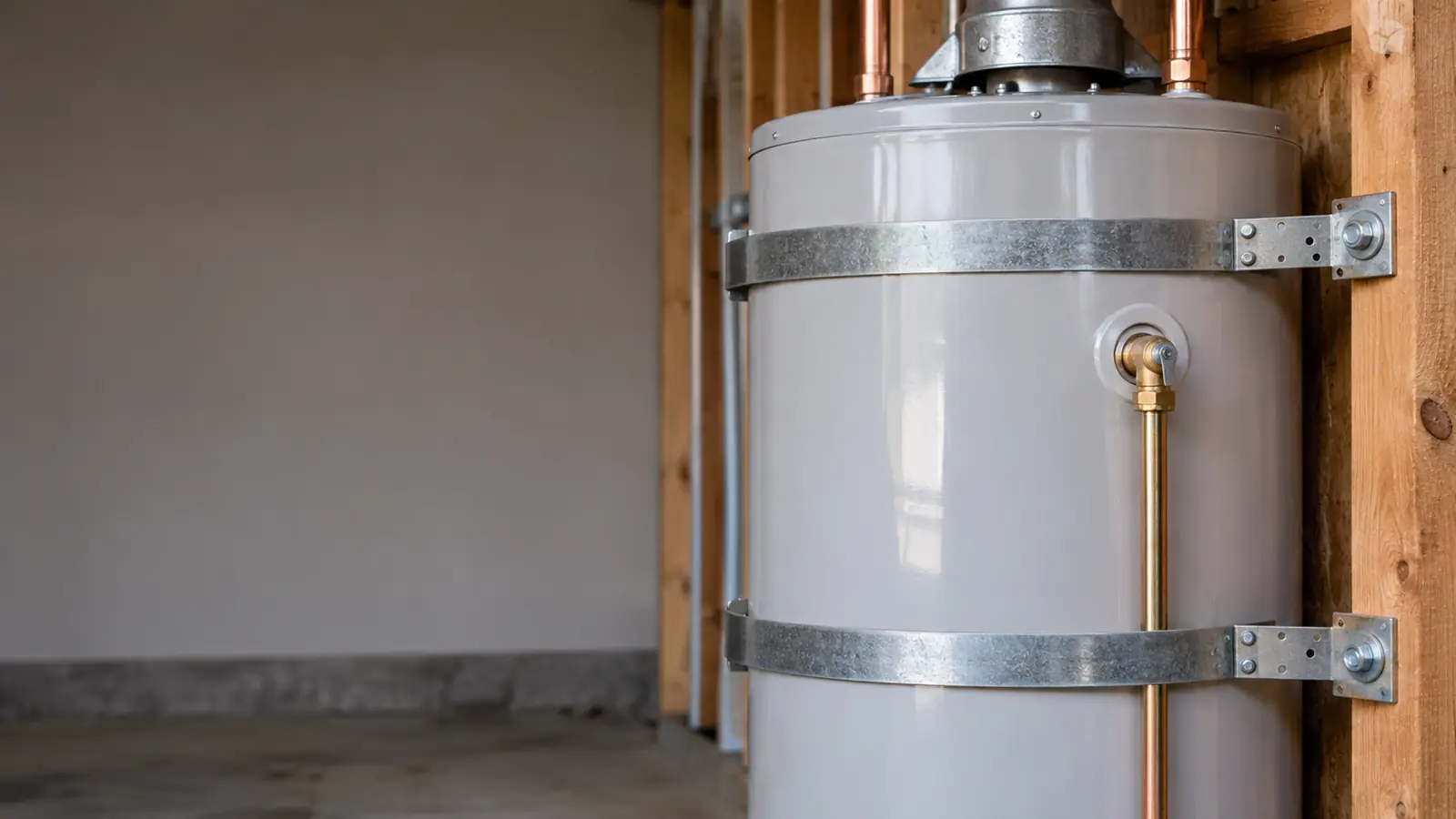
California requires every water heater to be strapped against earthquakes. Code calls for two straps: one in the upper third and one in the lower third, at least 4 inches above the controls.
Why California Requires Water Heater Straps
An unstrapped water heater can tip over in an earthquake, breaking its gas line and water connections. A broken gas line can start a fire, and a fallen tank floods the home. California state law requires water heaters to be braced, anchored or strapped, and the Los Angeles Department of Building and Safety (LADBS) publishes a bulletin showing approved methods.
Strapping Requirements at a Glance
| Requirement | Rule |
|---|---|
| Number of straps | Two |
| Upper strap | Within the upper one-third of the tank |
| Lower strap | Within the lower one-third, at least 4 in. above the controls |
| Attachment | Wrapped around the tank and fastened to wall studs or masonry |
| Code section | California Plumbing Code 507.2 |
Other Code Items Checked at Inspection
- Temperature and pressure relief valve with a full-size discharge line to an approved location
- Gas shut-off valve and an approved flexible connector
- Venting with correct clearances and a vent cap
- Expansion tank where the system has a check valve or pressure regulator
- Elevation of 18 inches for gas heaters in garages, where required
- Drain pan where a leak could damage the building
Do You Need a Permit to Replace a Water Heater?
Yes. In Los Angeles and throughout California, replacing a water heater requires a plumbing permit and a final inspection. The inspector checks the straps and the items above. Real estate sales often require proof of strapping too.
Can You Strap a Water Heater Yourself?
Yes. A homeowner can install a listed strap kit on an existing heater. Replacing the heater itself involves gas, venting and a permit, so most homeowners hire a licensed plumber for water heater installation. Strapping is one item on our earthquake plumbing checklist.
How to Strap an Existing Water Heater
A homeowner can add straps to an existing water heater with a listed strap kit. Follow the kit's instructions, which typically include these steps:
- Find the wall studs behind the heater with a stud finder.
- Measure the tank height and mark the upper and lower thirds.
- Position the lower strap at least 4 inches above the gas control valve.
- Wrap each strap fully around the tank and fasten both ends to studs with the supplied lag screws.
- Fill any gap between the tank and wall with the kit's spacer so the tank cannot rock.
- Check that the gas and water connections are flexible, not rigid.
Common Strapping Mistakes
- One strap instead of two. Code requires both an upper and a lower strap.
- Straps fastened to drywall only. Screws must reach studs or masonry.
- Lower strap over the controls. It must sit at least 4 inches above them.
- Thin plumber's tape wrapped loosely. The tank can still slide out.
- Rigid gas or water connectors. These can break even when the tank stays upright.
Water Heaters in Garages
A water heater in a garage has extra requirements beyond straps. Gas water heaters in garages generally must be elevated so the burner sits at least 18 inches above the floor, unless the heater is listed as resistant to flammable vapor ignition. A heater in the path of a vehicle needs protection, such as a barrier post, so a car cannot strike it. The inspector checks both during the permit inspection.
Strapping When You Sell a Home
California Health and Safety Code Section 19211 requires sellers of real property to certify to the buyer, in writing, that the water heater is braced, anchored or strapped. Home inspectors check strapping, and buyers often ask sellers to correct it before closing. Strapping the heater before listing removes one item from the repair list.
What a Strap Kit Includes
A listed water heater strap kit contains two heavy-gauge metal straps, lag screws for wood studs or anchors for masonry, spacers to fill the gap between tank and wall, and instructions showing the approved placement. Kits are sized by tank capacity, so check the gallons on the heater's label before buying one.
Other Earthquake Protection for Water Heaters
- Flexible gas connector so the gas line does not snap if the tank shifts
- Flexible water connectors on the hot and cold lines
- Seismic gas shut-off valve at the meter that closes during strong shaking
- Secure platform fastened to the floor and wall if the heater sits on a stand
Checking Straps on an Older Water Heater
Straps installed years ago can loosen as wood shrinks or after small earthquakes. Push gently on the top of the tank; it should not move. Replace thin plumber's tape with a listed strap kit.
When to Call a Plumber
If this guide matches what you see at home, our licensed plumbers can inspect it and give you a written price. Call (747) 285-3582 to book a plumbing inspection.
Related Questions
Do tankless water heaters need straps?
Wall-mounted tankless units are bolted to the structure instead of strapped, but their gas and water connections must still meet code.
Is plumber's tape allowed for strapping?
It depends on the method. LADBS shows approved heavy-gauge strapping methods, and a listed strap kit is the simplest way to meet the requirement.
Do inspectors check strapping on an existing heater?
Yes, during any permitted work on the heater and often during home inspections for a sale.
How much does it cost to strap a water heater?
A strap kit costs far less than replacing a fallen heater. A plumber can install one during any service visit for a small added charge.
Can I use one long strap wrapped twice?
No. Code calls for two separate straps placed in the upper and lower thirds of the tank.
Do straps need replacing with a new heater?
Yes, in most cases. A new kit sized for the new tank is installed with every replacement.