
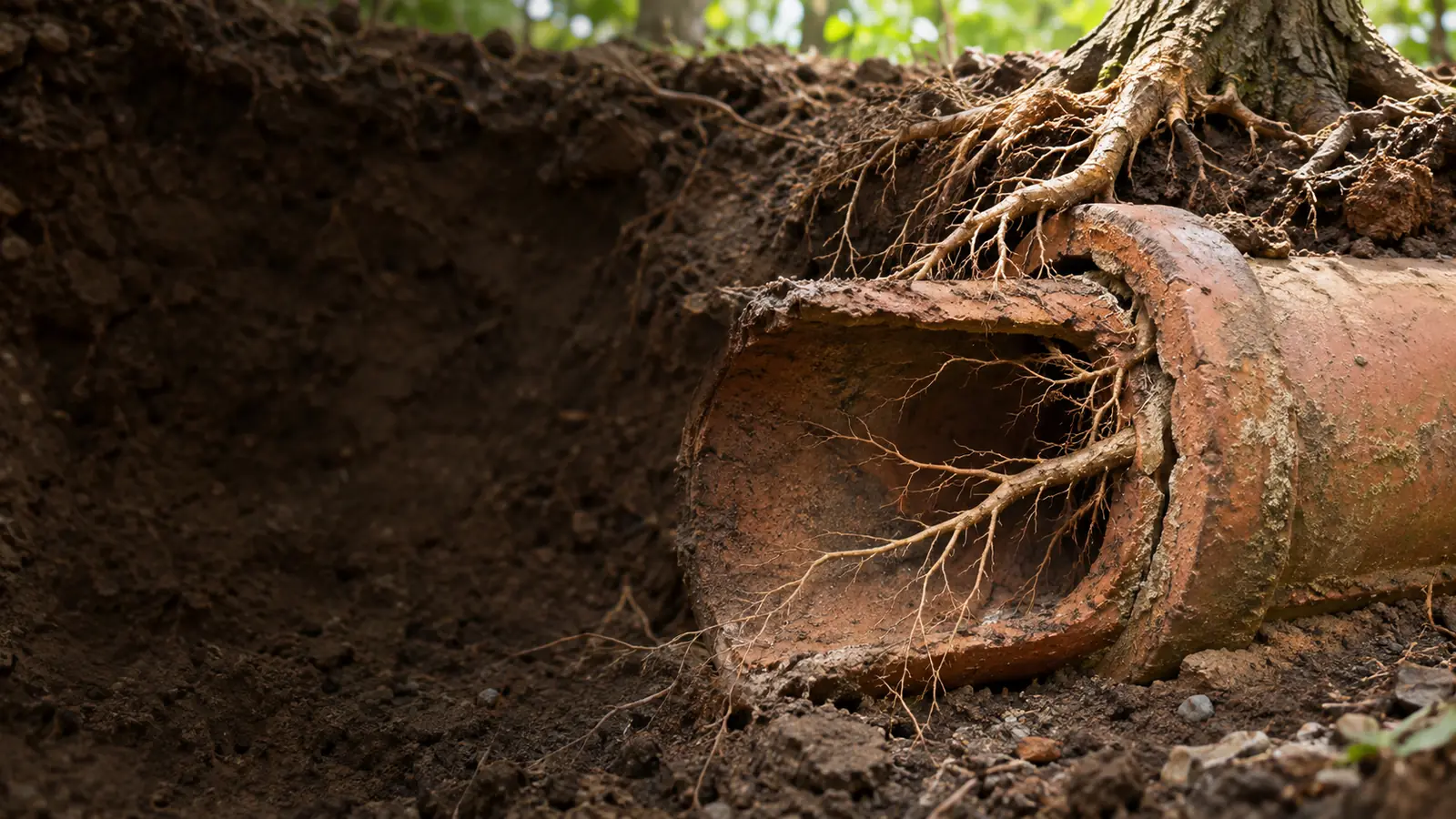
Tree roots enter sewer lines through cracks and loose joints, drawn by water and nutrients. Cutting or hydro jetting clears them temporarily; lining or replacing the damaged pipe stops them returning.
Why Tree Roots Grow Into Sewer Pipes
Roots grow toward water, oxygen and nutrients, and a sewer line leaks all three from tiny gaps at its joints. Clay pipe, common in mid-century Granada Hills homes, has joints every few feet that loosen over time. A hair-thin root enters a gap, feeds on the moisture inside and thickens into a mat that catches paper and grease until the line blocks.
Signs of Root Intrusion
- Slow drains throughout the house that get worse over months
- Gurgling toilets and drains
- Main-line clogs that return after snaking
- Backups that follow the growing season
- A camera inspection showing fine root hairs or root balls at joints
Trees and Shrubs Most Likely to Cause Problems
Fast-growing, thirsty trees cause the most sewer problems. In Valley yards these often include ficus, pine, eucalyptus, willow, poplar and mature citrus planted near the sewer path. Any tree can send roots into a leaking pipe if it is close enough.
How Roots Are Removed
| Method | How it works | How long it lasts |
|---|---|---|
| Mechanical root cutting | A cable with a cutting blade shears roots at the pipe wall | Short term; roots regrow |
| Hydro jetting | High-pressure water with a root-cutting nozzle cleans the full pipe | Longer than cutting; roots regrow through damaged joints |
| Chemical root treatment | Foaming herbicide kills roots inside the pipe | Temporary; follow label and local rules |
| Pipe lining | A liner seals the joints roots grow through | Long term |
| Pipe replacement | New jointless HDPE or PVC pipe | Long term |
Cutting and jetting restore flow but leave the entry points open. The lasting fix is to seal or replace the damaged joints.
How to Prevent Root Problems
- Find your sewer line's path with a camera locator before planting.
- Plant trees well away from the sewer line, choosing slow-growing species near it.
- Schedule cleaning every 12 to 24 months for a line with known roots.
- Repair or line the pipe when inspection shows root entry at several joints.
Should You Remove the Tree?
Not always. A tree that adds shade and value can often stay if the sewer line is lined or replaced with jointless pipe, which roots cannot enter. Removing the tree without fixing the pipe leaves the joints open for the next tree's roots.
What a Camera Shows About Roots
| Camera finding | What it means |
|---|---|
| Fine root hairs at a joint | Early intrusion; cleaning and monitoring |
| Root mass filling part of the pipe | Reduced flow; jetting and planning a repair |
| Root ball blocking the pipe | Backup risk; clear now, repair soon |
| Roots plus cracked or offset pipe | Structural damage; lining or replacement |
The Cost of Ignoring Roots
Roots that are cleared but never repaired come back, and each return can bring a backup into the house. Over several years, repeated emergency cleaning, water damage cleanup and a pipe that finally cracks can cost more than repairing the joints when roots were first found. A camera inspection gives you the information to plan the repair on your schedule.
Planting Near Your Sewer Line
Before planting a tree, locate your sewer line with a camera and locator. Choose slow-growing, smaller trees near the line and keep larger trees well away from it. Root barriers can help steer roots away from a pipe, but they do not replace a sound, sealed line.
Root Intrusion in Older Valley Neighborhoods
Granada Hills grew on former orchard land, and many yards still have mature citrus and large shade trees planted decades ago. Those trees were often planted without regard to where the sewer lateral ran. As the original clay pipe aged, its joints loosened just as the trees' roots spread wider, which is why root intrusion is one of the most common sewer problems in the area. Homes that changed hands without a sewer inspection may have roots the current owner does not know about until the first backup.
A Long-Term Plan for Root-Prone Lines
- Clear the line with hydro jetting and a root-cutting nozzle.
- Inspect it with a camera and mark where roots enter.
- Repair the damaged joints with lining or spot repairs, or replace the line if damage is widespread.
- Until repairs are made, schedule cleaning before backups typically recur.
- Keep the video and repair records with your home documents.
Roots in Shared and Neighboring Lines
Roots in your lateral are your plumbing problem even when the tree is on a neighbor's lot. Before cutting or removing a neighbor's tree, talk with them and check local rules. Repairing your own pipe is the lasting fix either way.
When to Call a Plumber
If this guide matches what you see at home, our licensed plumbers can inspect it and give you a written price. Call (747) 285-3582 to book a plumbing inspection.
Related Questions
Can roots break a sewer pipe?
Yes. Roots widen joints and cracks as they grow, and heavy root growth can crack or collapse clay pipe.
Does root killer work?
Foaming root treatments can slow regrowth after cleaning, but they do not repair the joints roots enter through.
Is my neighbor's tree my responsibility?
Roots in your lateral are your plumbing problem regardless of where the tree stands. Talk with your neighbor before removing or cutting their tree.
How often do roots grow back after cleaning?
It varies with the tree and the pipe damage. Many lines with root entry need cleaning every one to two years until repaired.
Will cutting roots in my pipe kill the tree?
Removing roots inside a sewer pipe rarely harms a healthy tree. Cutting major roots outside the pipe is a different matter; consult an arborist.
Do PVC sewer pipes get roots?
Rarely. Glued PVC joints resist roots far better than clay, though roots can enter through cracks or poorly sealed connections.